# Scheduling
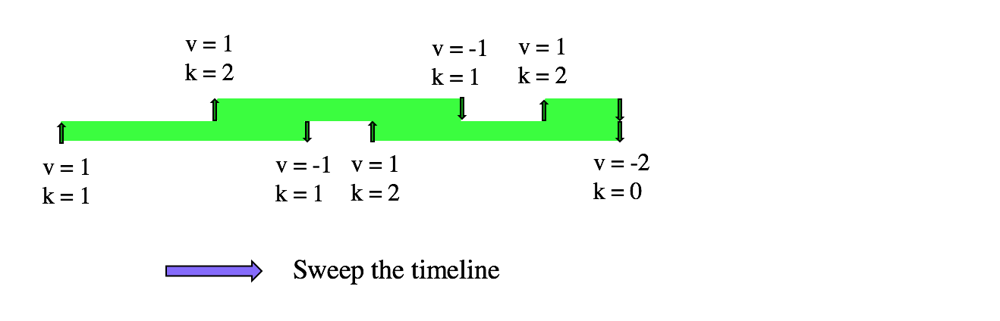
has come up with the [HashMap/TreeMap algorithm](https://leetcode.com/problems/my-calendar-iii/discuss/109556/JavaC++-Clean-Code) to sort the intervals and record the overlaps. The algorithm can be applied to the aforementioned problems with `O(nlogn)` time complexity.
Here is the idea -
1. Load all intervals to the `TreeMap`, where keys are intervals' start/end boundaries, and values accumulate the changes at that point in time.
2. Traverse the TreeMap (in other words, sweep the timeline). If a new interval starts, increase the counter (`k` value) by 1, and the counter decreases by 1, if an interval has finished.
3. Calcalulate the number of the active ongoing intervals.
In the following graph, there are 4 intervals/meetings, the `k` value is the number of rooms or booking sessions.
## Problems
* [Merge Intervals](https://leetcode.com/problems/merge-intervals/description/)
* [Insert Interval](https://leetcode.com/problems/insert-interval/description/)
* [Meeting Rooms](https://leetcode.com/problems/meeting-rooms/description/)
* [Meeting Rooms II](http://leetcode.com/problems/meeting-rooms-ii/)
* [My Calendar I](https://leetcode.com/problems/my-calendar-i/description/) (Not the most optimal sol using this approach)
* [My Calendar II](https://leetcode.com/problems/my-calendar-ii/description/) (Not the most optimal sol using this approach)
* [My Calendar III](https://leetcode.com/problems/my-calendar-iii/description/) (Not the most optimal sol using this approach)
*
* [Employee Free Time](https://leetcode.com/problems/employee-free-time/discuss/175081/Sweep-line-Java-with-Explanations)
* [Car Pooling](https://leetcode.com/problems/car-pooling/)
* > thanks for this, such O(n(log(n)) approach using sorted map (TreeMap/RedBlack Tree) also works for car pooling () but there is a more efficient O(n) solution if number of locations is constrained in range (e.g. from 0 to 1000) :
## Examples
\
**252. Meeting Rooms**
```java
public boolean canAttendMeetings(Interval[] intervals) {
Map map = new TreeMap<>();
for (Interval itl : intervals) {
map.put(itl.start, map.getOrDefault(itl.start, 0) + 1);
map.put(itl.end, map.getOrDefault(itl.end, 0) - 1);
}
int room = 0;
for (int v : map.values()) {
room += v;
if (room > 1) return false;
}
return true;
}
```
**253. Meeting Rooms II**
```java
public int minMeetingRooms(Interval[] intervals) {
Map map = new TreeMap<>();
for (Interval itl : intervals) {
map.put(itl.start, map.getOrDefault(itl.start, 0) + 1);
map.put(itl.end, map.getOrDefault(itl.end, 0) - 1);
}
int room = 0, k = 0;
for (int v : map.values())
k = Math.max(k, room += v);
return k;
}
```
**731. My Calendar II**
```java
private TreeMap map = new TreeMap<>();
public boolean book(int s, int e) {
map.put(s, map.getOrDefault(s, 0) + 1);
map.put(e, map.getOrDefault(e, 0) - 1);
int cnt = 0, k = 0;
for (int v : map.values()) {
k = Math.max(k, cnt += v);
if (k > 2) {
map.put(s, map.get(s) - 1);
map.put(e, map.get(e) + 1);
return false;
}
}
return true;
}
```
**732. My Calendar III**
```java
Map map = new TreeMap<>();
public int book(int start, int end) {
map.put(start, map.getOrDefault(start, 0) + 1);
map.put(end, map.getOrDefault(end, 0) - 1);
int cnt = 0, k = 0;
for (int v : map.values()) {
cnt += v;
k = Math.max(k, cnt);
}
return k;
}
```
A bit more complicated:\
**56. Merge Interval**
```java
public List merge(List intervals) {
Map map = new TreeMap<>();
for (Interval itl : intervals) {
map.put(itl.start, map.getOrDefault(itl.start, 0) + 1);
map.put(itl.end, map.getOrDefault(itl.end, 0) - 1);
}
List list = new LinkedList<>();
int start = 0, cnt = 0;
for (Map.Entry e : map.entrySet()) {
if (cnt == 0) start = e.getKey();
// if cnt is 0, that means a full interval has been completed.
if ((cnt += e.getValue()) == 0)
list.add(new Interval(start, e.getKey()));
}
return list;
}
```